
Personalized Precision Healthcare - part 3 - Embryology
What happens in the womb has an ongoing domino effect on the rest of your life
Did you watch the 'Divergent' film trilogy?

If you did, you will remember in the first film, we were shown a society where people are divided into 5 distinct factions, each one dedicated to cultivating a specific virtue in order to maintain peace. In the series, every person in society is assigned to a faction based on their innate skills and talents:
For example, due to their incorruptible nature and selflessness, 'Abnegation' (The Selfless) traditionally run the government (gosh wouldn't that be nice in real life, lol), whilst 'Erudite' (The Intelligent) are logical, knowledgeable and intelligent, and act as society's scientists, researchers, and educators.*
The point here, in relation to personalized Precision Healthcare, is that each person is born with unique values, virtues and talents, which means they all think and behave differently according to these innate qualities. Their individual makeup is inherent from birth.
So it is with us humans when it comes to our body and health.
As we have seen in part 1 and part 2 of this series, we all have a completely unique geneology and genetic makeup which when interacting with the environment leads to our own distinct phenotype: genes are activated or deactivated based on inputs from the environment, which includes a multitude of factors such as food, exercise, thoughts, emotions, stress, toxins, environmental space, work, social connections and more.
Now we're going to go beneath the surface and look at how and why each individual's phenotype is different, due to embryology* and endocrinology*.
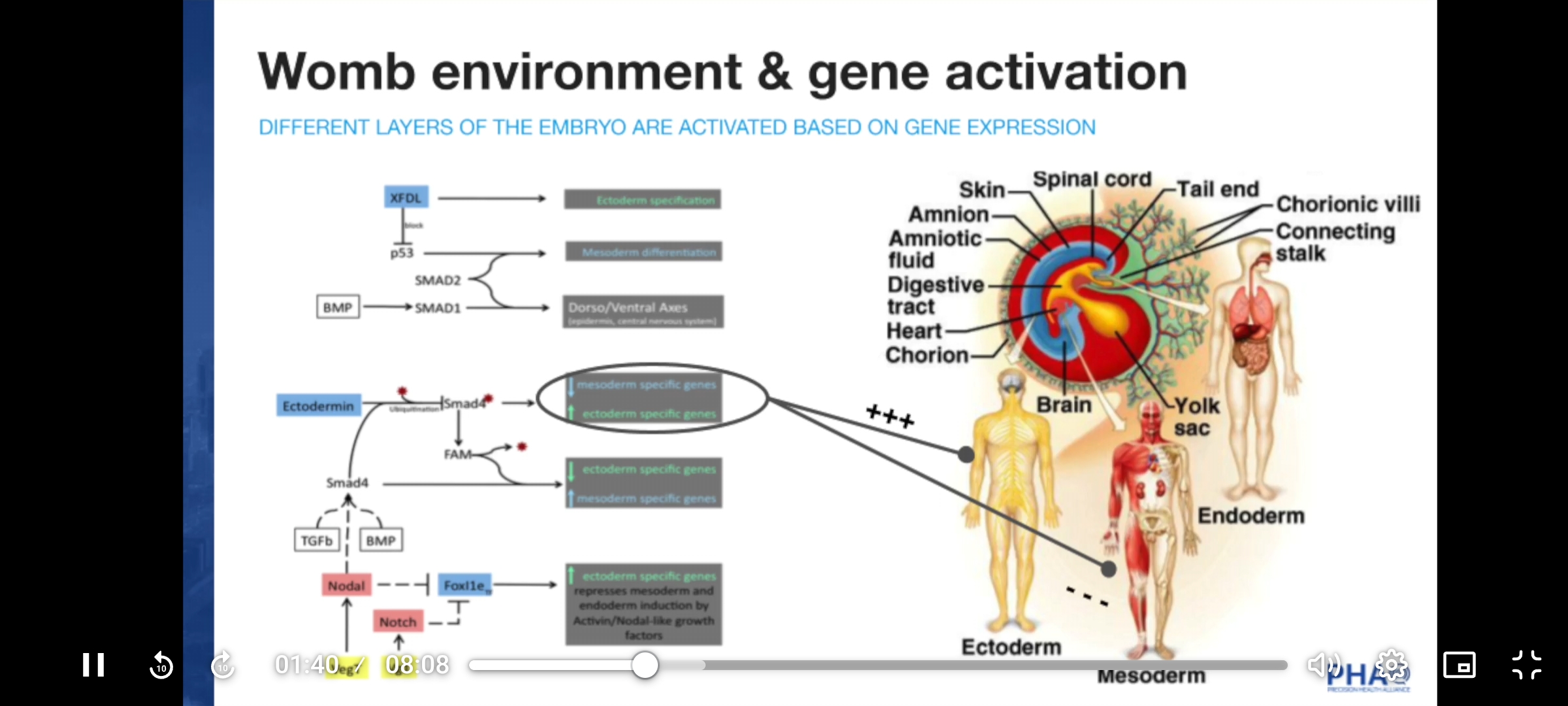
In the womb, as the zygote* grows, when the embryo reaches 64 cells it splits into 3 distinct 'germ' layers*.
These layers act as the fundamental building blocks of an organism, eventually giving rise to all the body's tissues and organs:
- The 'Ectoderm' (outer) layer forms the skin and nervous system
- The 'Mesoderm' (middle) layer forms the muscular skeletal, heart and reproductive systems
- The 'Endoderm' (outer) layer becomes the digestive system, pancreas, liver, lungs and thyroid
As each embryo grows, in different individuals, one of these 3 germ layers will develop to a greater degree than the other two, and this leads to different organ systems in the body developing slightly differently.
Each germ layer also has a different propensity for producing certain hormones, leading to each germ layer having a dominant hormone type.
This results in different people developing different organ structure and morphology, and their body metabolizing differently, according to which germ layer is dominant.
It also leads to different people having a different body type, resulting in people developing their own HealthType™ (which will be discussed in the next post).
So now we see how genetics, combined with embryological layer and hormonal development, lead to each person developing their own unique body type, with certain cells and organs being more 'robust' than others.
- Can you see then how you specifically grow in the womb, and which germ layer becomes dominant, will affect how your body functions?
- Can you see how people with different body types may are prone to manifesting different health issues?
- Can you understand why people are different shapes and sizes?
This genetic make up and morphology also have a strong influence our personality and behaviour.
So we can begin to understand that happens in the womb has a domino effect on the rest of our life!
Measuring embryos for morphology
How can we know which 'body type' we are?
Obviously it would be quite tricky to see which bodytype is forming at 64 cells in the womb (although maybe in the not too distant there will be ways of doing this).
The good news is our unique morphology can be assessed through anthropometry - the science of measuring specific body parts as a child or adult, eg the length of a finger or femur.
For example, if your ring finger is longer than your index finger, it points to more testosterone being produced in embryo, which means you are more likely to be more assertive (or even aggressive) as an adult.
Or more hyper-mobile joints is symptomatic of more collagon being produced during embryonic developement.
In addition, our ancestry and lineage will affect which location or part of world will suit us better. For example, have you noticed you just 'feel' better or thrive better in certain climates? (Personally I just love, love, love dry, alpine climates, which is one of the reasons I moved from the damp North Island to the dry South Island a few years ago - I'm 'in my element' in dry, cool climates).
So by determining our body type (as a result of which germ layers grow more dominantly in the womb), we can determine our HealthType™.
In Precision Healthcare there are 6 main HealthTypes, 3 of which are formed directly from the 3 germ layers (ectoderm, mesoderm, endoderm) and 3 of which are a combination of 2 of the 3 germ layers.
We'll look at HealthTypes™ in the next post...
Want to discover your HealthType™? Join the June 2026 5 Day Challenge
References
*Divergent Film Series (source: Wikepedia)
- Abnegation (The Selfless): Values selflessness and putting others before oneself. They believe that focusing on others prevents selfishness and conflict, and because of their incorruptible nature, they traditionally run the government. [1, 2, 3, 4, 5]
- Erudite (The Intelligent): Values knowledge, logic, and intelligence. They believe that ignorance is the root of all evil and act as the society's scientists, researchers, and educators. [1, 2, 3, 4]
- Dauntless (The Brave): Values bravery, courage, and fearlessness. They serve as the military, guards, and protectors of the city, pushing members through highly physical and mental initiation tests. [1, 2, 3]
- Amity (The Peaceful): Values kindness, peace, and harmony. They avoid conflict and war at all costs and are responsible for agriculture and providing food for the city. [1, 2, 3]
- Candor (The Honest): Values honesty and truth. They believe deceit is the root of conflict, so they operate the judicial and legal systems using strict truth and justice. [1, 2, 3, 4, 5]
* Embryology (source: Google)
Embryology is the branch of biology that studies the prenatal development of gametes, fertilization, and the development of embryos and fetuses. It covers the entire process from a single-celled zygote to the creation of complex tissues, organs, and a fully formed organism. [1, 2, 3]
* Endocrinology
Endocrinology is the branch of medicine dedicated to studying the endocrine system and the hormones it produces. It focuses on diagnosing and treating hormone imbalances and diseases related to the body's glands, including the thyroid, pituitary, pancreas, and adrenal glands. [1, 2]
*Zygote (source: Google)
A zygote is the initial, single-celled organism formed when a sperm and an egg fuse during fertilization. It represents the earliest stage of development for sexually reproducing organisms and contains a complete set of combined chromosomes, carrying all the genetic instructions needed to grow into a new individual. [1, 2, 3]
*Germ Layers (source: Google)
A germ layer is a primary layer of cells formed during early embryonic development. These layers act as the fundamental building blocks of an organism, eventually giving rise to all specific tissues and organs in the body. [1, 2, 3]
*Morphology
Morphology is the scientific study of form and structure. Depending on the field, it typically refers to the structure of words in linguistics, the physical shape and traits of organisms in biology, or specific visual characteristics in medical sciences.
